The Strange and Wondrous Works of Eleanor Eleanor by Kathryn Cowles, Review by Dana Alex King
Posted on May 13, 2026
Strange and Wondrous: The Works of Kathryn Cowles and Eleanor Eleanor
The Strange and Wondrous Works of Eleanor Eleanor: A Catalogue, Kathryn Cowles. Astoria, New York: Fence Books, 2025 (ISBN 13: 979-8989978533)
The Strange and Wondrous Works of Eleanor Eleanor is a brilliant and bittersweet read. It is ekphrasis turned inside-out and placed within a framing device created with rare sincerity and care. As readers, we know that Eleanor Eleanor is Cowles’s creation. At the same time, we are brought to understand that Eleanor Eleanor is as substantial an individual as can be. What does it matter whether Eleanor has ever been a corporeal being? In Cowles’s expert hands, we meet a person whom she has known all her life, though a person who has been defined as much by her periods of absence as by the moments of her presence.
Undoubtedly, The Strange and Wondrous Works of Eleanor Eleanor considers both presence and absence to be defining characteristics of Eleanor Eleanor the individual and of her artistic works. In both the written and visual elements of this collection, Cowles uses techniques that bring to mind Negative Theology–techniques that are particularly poignant when used to describe the tragedy of miscarriage as a possible facet of motherhood. In the poem Pocket I, Cowles gives us the lines:
Glass doesn't blow that way so I use a glass mold made of two halves of metal, fit the halves around a hot thick start of molten glass and begin to blow slowly the shell of glass expanding and forming around the absent baby
Meanwhile, Cowles’s notion of the complex relationship between absence and presence is striking in the poems and images that display Eleanor Eleanor’s fiery response to questions of personal and artistic authenticity and integrity. As one who has had to navigate the gendered expectations of societal and artistic institutions, Eleanor Eleanor is well aware of the inequalities that are endemic to these institutions, just as she is aware that the burden of living up to these expectations is presented to women like herself as a moral imperative. “Music swelled. // I pulled my head outside of my head // to watch…” she tells us, and “Girls watch people watch them and so // can picture themselves from away, two-placed. // This is a kind of art.” Addressing the male members of her audience, she adds, “Wheareas You are your own head, a site of looking-from, // making objects of everything you can see” These lines are selected from the poem Object/Subject 2: Looker, a poem in which Cowles wonders how she can impress the experience of oneself as both a self and an object upon a male audience. Fortunately, Eleanor Eleanor has an emphatic solution.
In the creation of The Strange and Wondrous Works of Eleanor Eleanor, Katheryn Cowles has asked a lot of herself and has decidedly met her own challenge. Here, the individual written and visual works are ambitious and determinedly self-defined, as is the entire collection. Cowles uses cultural symbolism in a way that is both critical and idiosyncratic. Meanwhile, she navigates the balancing act of creating and discovering through the same working processes. The result is a compelling personal mythology, not of Cowles, but of Eleanor Eleanor, a character one degree removed from our world. As a result, the words and images create a mysticism that is rooted in the everyday. And as we approach the book’s thoughtful curation, we become aware of a purposeful trajectory that moves through tragedy, unearned guilt, frustration, suffocating circumstances, relentless effort, and triumph. It is perfectly appropriate that the destination of this trajectory is a new beginning, open-ended and ecstatic.
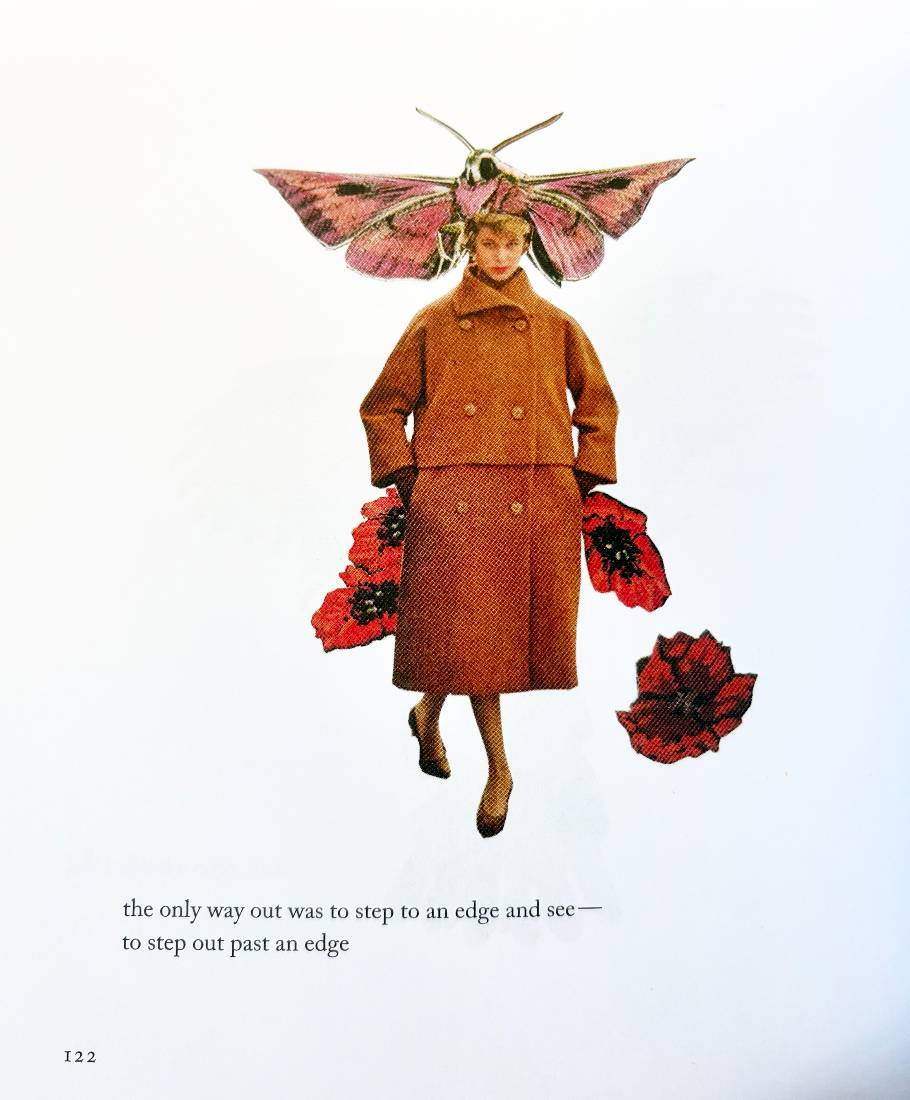
Eleanor Eleanor never intended to stay, not with us and not with Cowles. To say goodbye is painful and satisfying at the same time; we are saying goodbye to a figure as large as life and as real as death, a figure who has cut herself out of a page too small to hold her in order to follow a vision of “another whole sky,” one that can be discovered only by stepping out past an edge to see it.